Can You Pour Concrete in Winter in Northern Denver? Cold-Weather Facts
Yes, you can pour concrete in winter in Northern Denver.
Crews do it every year across Brighton, Thornton, Westminster, and the surrounding communities, and the results hold up for decades. The season is not the problem. An unprotected pour is.
That distinction matters because winter concrete has a reputation it only half deserves. Homeowners hear that cold ruins concrete, which is true right up until you understand what actually causes the damage and how a crew prevents it. This guide covers what the standards require, the simple rule we use to pick a winter pour date, the specific protections that go into a cold-weather job, and the situations where we tell homeowners to wait until spring.
Can You Pour Concrete in Winter in Northern Denver
Winter pouring in Northern Denver is restrictive but entirely doable. Sudden cold snaps and heavy snow dumps limit the number of workable days, so the calendar is tighter than in spring or fall. But Colorado also hands us something most cold-climate states never get: bright, dry, 60 degree winter afternoons that arrive between storm systems.
Those days are the opening. A crew that knows how to read Front Range weather can find them, plan around them, and place concrete that cures properly. The requirement is not a warmer month. It is warm mix water, air-entrained concrete, insulated blankets, and the patience to leave protection in place until the slab is strong enough to survive a freeze.
If your project can flex to spring or fall, those windows remain easier, as we explain in our guide to the best time of year to pour concrete in Northern Denver. If your timeline cannot wait, keep reading.
What ACI 306 Actually Says About Cold-Weather Concrete
The American Concrete Institute publishes the standard the industry works from, ACI 306R, Guide to Cold Weather Concreting. It defines cold-weather concreting as any period when the average daily air temperature stays below 40 degrees Fahrenheit for more than three consecutive days, or when the air temperature stays below 50 degrees for more than half of any 24-hour period.
Read that carefully, because it is not a prohibition. It is a trigger. Once conditions meet that definition, the pour moves from standard practice to protected practice. The concrete still gets placed. It simply gets placed with a specific set of controls that a summer pour does not need.
Concrete gains strength through hydration, a chemical reaction between water and cement that builds interlocking crystals inside the slab. That reaction is temperature-sensitive. Below 50 degrees it slows noticeably. Below 40 degrees it nearly stops. Cold does not merely delay a pour, it changes the chemistry of how the slab develops strength, which is why the protections exist.
Why 500 PSI Is the Number That Matters
Here is the single most important fact in cold-weather concreting. Fresh concrete must reach a compressive strength of roughly 500 PSI before it can safely survive a freeze. Below that threshold, the water inside the mix freezes, expands by about nine percent, and physically tears apart the crystal structure that was forming. The damage is permanent. A slab that freezes early can lose up to half its potential strength, and no amount of later warm weather repairs it.
Once concrete passes 500 PSI, a single freeze-thaw cycle will not damage it. The slab goes on to reach its full design strength normally. Every protection described below exists for one purpose: to buy the slab enough warm time to cross that line.
One more detail worth knowing. Fresh concrete does not freeze at 32 degrees. Because of the dissolved salts in the mix, it freezes closer to 27 degrees. That small margin is real, but it is not a cushion any responsible crew relies on.
Here is how the key cold-weather temperature thresholds line up.
| Threshold | What It Means |
|---|---|
| Below 40 degrees F for 3+ days | ACI 306 cold-weather concreting is triggered. Protected practice required. |
| Below 50 degrees F | Hydration slows noticeably. Strength gain and set times extend. |
| Below 40 degrees F | Hydration nearly stops without added heat. |
| Approximately 27 degrees F | Fresh concrete freezes. Below 500 PSI this causes permanent damage. |
| 500 PSI compressive strength | Safe threshold. One freeze-thaw cycle will not damage the slab past this point. |
The 40F and Rising Rule
Standards tell you what to protect against. Scheduling tells you when to pour. For Northern Denver winters, we plan around a simple guide we call the 40F and Rising Rule.
Look for a day when the air temperature is at least 40 degrees Fahrenheit and climbing rather than falling, ideally landing on the front edge of a warm stretch rather than the tail end of one. A pour placed at 42 degrees on a morning headed toward 60 is in far better shape than the same pour placed at 42 degrees on an afternoon headed toward 20 overnight. The direction the thermometer is moving matters as much as the number on it.
This is where Colorado works in your favor. Northern Denver winters deliver frequent sunny days in the 50s and 60s, often within a day or two of a snowstorm. Those clear, dry, high-pressure stretches are legitimate pouring windows, not flukes. The trick is recognizing them early enough to schedule concrete delivery and crew.
Reading a Northern Denver Winter Forecast
A workable winter pour window generally means daytime highs at or above 40 degrees and rising, overnight lows that stay manageable under blankets for the next three days, no incoming storm system within roughly 48 hours, and ground that is not frozen.
That last one surprises people. The subgrade matters as much as the air. We cover site prep in depth in our guide to the concrete driveway installation process, and in winter that prep step carries extra weight.
The forecast horizon that matters is not the pour day, it is the 72 hours after it. That is the protection period, and it drives the entire decision.
Use this quick checklist to judge whether a winter window is workable.
| Condition | Green Light | Postpone |
|---|---|---|
| Daytime temperature | 40 degrees F and rising | Below freezing all day |
| 72-hour forecast | Stable or warming | Deep freeze incoming |
| Subgrade condition | Frost-free and drained | Frozen or saturated |
| Incoming storm within 48 hrs | None expected | Snow event forecast |
| Project type | Structural flatwork | Stamped or decorative |
What Actually Goes Wrong in a Cold Pour
Understanding the failure modes makes the protections make sense.
Early-age freezing is the serious one. If the slab drops below about 27 degrees before reaching 500 PSI, ice crystals disrupt the paste and cause permanent strength loss. This is the failure that cannot be repaired.
Stalled hydration is the slow-motion problem. Concrete placed in cold that never freezes but never warms simply does not gain strength on schedule. Forms stay on longer, traffic gets delayed, and the project timeline stretches.
Surface scaling and dusting show up later. Excess bleed water worked into the surface during finishing, a common cold-weather mistake, leaves a weak top layer that flakes in the first spring thaw.
Thermal shock happens at the end. Pulling blankets off a warm slab into freezing air too abruptly creates a temperature differential that can crack the surface. Protection has to come off gradually.
How ANE Concrete Protects a Winter Pour
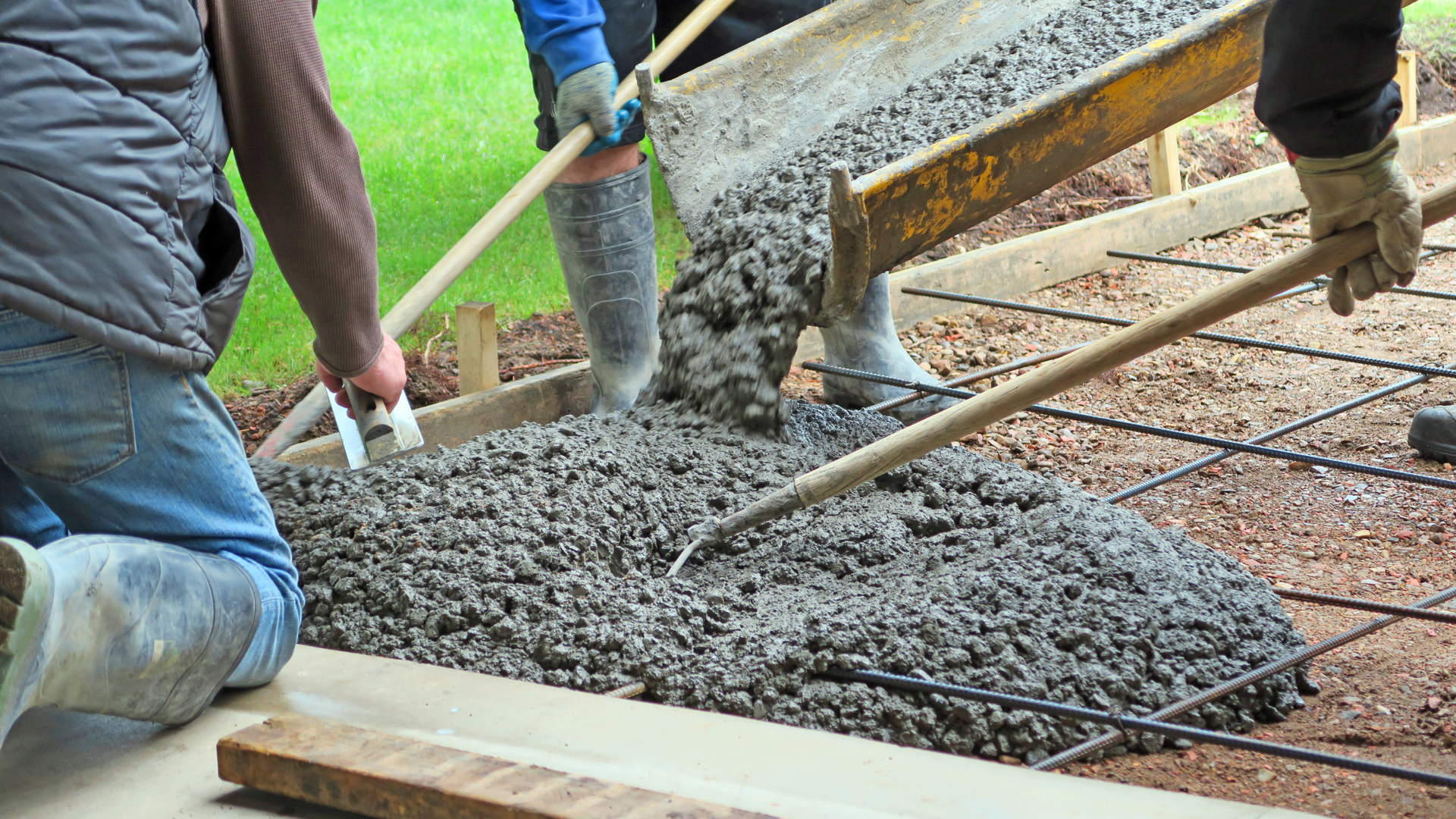
Cold-weather concreting is a procedure, not a gamble. Here is what goes into one.
Warm Mix Water and Admixtures
The mix arrives warm. Heated mix water raises the concrete's placement temperature so hydration starts strong instead of stalling on contact with cold ground. Accelerating admixtures can be added to speed early strength gain, shortening the window during which the slab is vulnerable. These are standard cold-weather tools, not shortcuts.
Air-Entrained Concrete
Air entrainment introduces microscopic air bubbles throughout the mix. Those bubbles give freezing water somewhere to expand into rather than forcing it against the paste. In a region that sees more than 100 freeze-thaw cycles a year, air-entrained concrete is valuable in any season and essential in winter.
Insulated Curing Blankets and the Protection Period
After finishing, the slab gets covered with insulated curing blankets that trap the heat hydration generates. The blankets stay on for the full protection period, typically three days and sometimes longer, until the concrete reaches 500 PSI. This is the step that gets skipped by crews cutting corners, and it is the step that determines whether the slab survives.
Removal is gradual. Blankets come off in stages so the slab cools toward ambient temperature rather than dropping suddenly.
Subgrade Preparation
Concrete cannot be placed on frozen ground. As frozen subgrade thaws, it settles unevenly and the slab above it cracks. Winter prep means confirming the base is frost-free, sometimes protecting the excavated area with blankets ahead of the pour, and verifying drainage before any concrete is ordered. Skipping this is one of the most common causes of winter slab failure.
Together, these are the six protections that make a winter pour work.
| Method | Purpose |
|---|---|
| Warm mix water | Raises placement temperature so hydration starts strong instead of stalling. |
| Accelerating admixtures | Speeds early strength gain, shortening the vulnerable window before 500 PSI. |
| Air-entrained concrete | Microscopic bubbles give freezing water room to expand, resisting freeze-thaw damage. |
| Insulated curing blankets | Trap hydration heat through the protection period until the slab clears 500 PSI. |
| Curing compounds | Lock surface moisture in against high-altitude sun and dry winter wind. |
| Frost-free subgrade prep | Prevents uneven settlement and cracking when frozen ground later thaws. |
The High-Altitude Sun and Wind Problem
Winter in Northern Denver is not only cold. It is also dry, sunny, and windy, and that combination creates a problem most homeowners never anticipate.
At roughly 5,000 feet, the high-altitude sun is intense even in January, and dry prairie winds pull moisture off a fresh surface quickly. Concrete that loses surface moisture faster than bleed water can replace it develops plastic shrinkage cracking, fine surface cracks that appear within hours of placement.
The counterintuitive result: a sunny, breezy 55 degree winter day can dry a slab surface faster than a humid summer morning. This is why our crews apply curing compounds to lock moisture into the slab, and why windbreaks sometimes go up around a winter pour. The same dynamic appears in July, which is why we discuss moisture retention in our concrete driveway maintenance in Brighton CO guide as well.
When We Tell Homeowners to Wait
An honest contractor turns work down sometimes. We recommend postponing a pour when the subgrade is frozen solid or heavily saturated with snowmelt, when a multi-day deep freeze is forecast within the protection period, when a major snow event is expected inside 48 hours, when temperatures will not climb above freezing at all during the day, or when the project involves decorative work such as stamped or colored concrete, where finishing quality depends on conditions we cannot fully control in cold.
That last one is worth emphasizing. Decorative and stamped finishes need a workable surface window that cold weather compresses. For those projects, waiting for spring produces a visibly better result, and we will say so rather than take the job.
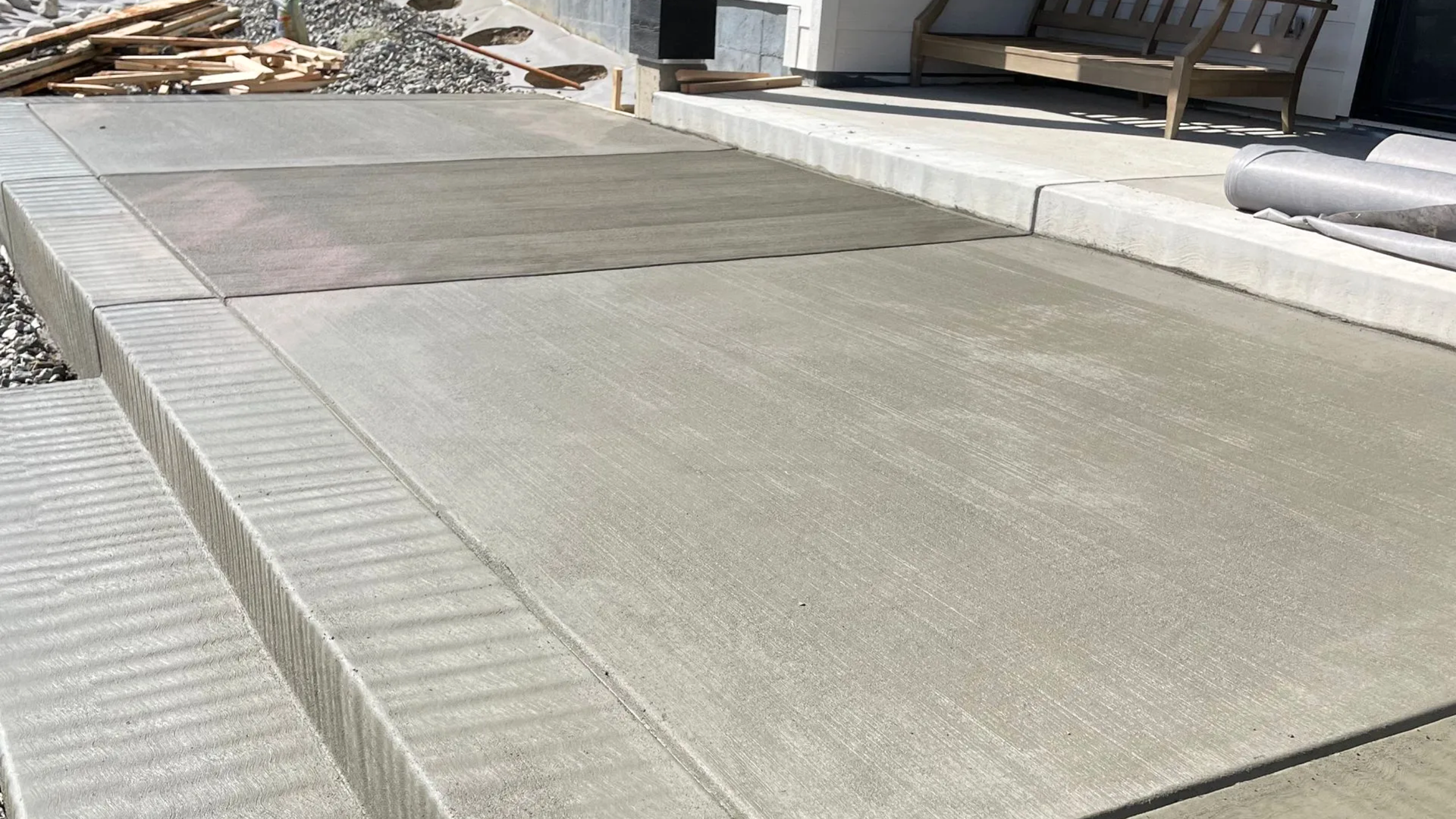
Structural flatwork like concrete slabs, concrete driveways, and utility concrete patios handles winter placement far more comfortably than decorative work does.
Winter Pour Advantages Most Homeowners Miss
There is a real upside to off-season work. Winter is the slow season for Northern Denver concrete contractors, so scheduling is easier and lead times shrink. A project that would wait weeks for a crew in June often books within days in January.
Cold ground also means less thermal expansion stress during initial curing compared to placing concrete on ground baked to high temperatures in midsummer. And finishing your project in winter means the slab is fully cured and ready for use when spring arrives, rather than losing the first good months of the year to construction.
For homeowners in Thornton, Westminster, and the surrounding areas planning a spring outdoor living project, a winter pour on the hardscape means the rest of the work can start on schedule.
What to Ask a Contractor Before a Winter Pour
If you are collecting winter bids, these questions separate crews that follow cold-weather practice from crews that hope for the best.
Ask what the concrete's temperature will be at placement, and whether they are using heated mix water. Ask whether the mix will be air-entrained and at what percentage. Ask how long blankets will stay on and how they determine the slab has reached adequate strength. Ask how they will confirm the subgrade is frost-free before pouring. Ask whether they monitor in-place temperature during the protection period, or simply estimate.
A crew that answers these confidently is doing cold-weather concreting. A crew that waves the questions off is gambling with your slab.
Frequently Asked Questions
Can you pour concrete in winter in Northern Denver?
Yes. Winter concrete pouring is common in Northern Denver and produces excellent long-term results when cold-weather methods are used. The pour requires warm mix water, air-entrained concrete, insulated curing blankets, and a protection period that lasts until the slab reaches about 500 PSI. What matters is not the season but whether the crew follows ACI 306 cold-weather practice.
What is the coldest temperature you can pour concrete in?
There is no single cutoff air temperature. ACI 306 defines cold-weather concreting as any period when the average daily air temperature stays below 40 degrees Fahrenheit for more than three consecutive days. Pours happen well below that with proper protection. The real limit is whether the concrete can be kept above freezing until it reaches roughly 500 PSI, and whether the subgrade is free of frost.
What is the 40F and Rising Rule for winter concrete?
It is a simple planning guide for Colorado winter pours. Look for a day when the temperature is at least 40 degrees Fahrenheit and climbing rather than falling, ideally on the front edge of a warm stretch. Northern Denver often delivers sunny 60 degree winter days, and those windows give a fresh slab the head start it needs before the next cold night arrives.
How long does concrete take to cure in cold weather?
Cold slows hydration, so cold-weather concrete gains strength more slowly than a summer pour. Below 50 degrees the reaction slows noticeably and below 40 degrees it nearly stops. Expect a longer protection period, often three to seven days under blankets, and plan on delayed traffic. Full design strength still takes about 28 days, sometimes longer in sustained cold.
Is winter concrete weaker than concrete poured in summer?
No, not when it is done correctly. A properly protected winter pour reaches full design strength and can outperform a summer slab that was placed in extreme heat without adequate curing. The risk is not the season itself, it is an unprotected pour. Concrete that freezes before reaching 500 PSI can lose a significant share of its potential strength permanently.
Does pouring concrete in winter cost more?
Cold-weather work adds some material and labor cost for warm mix water, admixtures, blankets, and the longer protection period. That is often offset by better contractor availability in the off season, since winter is the slow stretch for most Northern Denver concrete crews. Scheduling is usually faster and project timelines are easier to secure.
Planning Your Winter Concrete Project in Northern Denver
Winter concrete work in Northern Denver comes down to three things: watching for the 40F and rising window, protecting the slab until it clears 500 PSI, and being willing to postpone when conditions genuinely do not allow a quality pour. Handle those correctly and a January slab performs every bit as well as a June one.
As a local Brighton concrete contractor serving Brighton, Thornton, Westminster, Northglenn, Commerce City, Henderson, and Erie/Broomfield, ANE Concrete plans winter projects around Front Range conditions rather than against them. We will tell you honestly whether your project is a good candidate for a cold-weather pour or whether waiting will serve you better.
If you are considering concrete work this winter, request a free estimate and we will walk through your timeline, your site, and the weather window that fits your project.